Plant Proteomics and Bioinformatics
Group leader: Assoc. Prof. Dr. Ragab Abdel Gawad
Research interests:
Our main research interest is focusing on DNA-Repair Mechanisms in Plant and its related proteins. Interactome analysis of photoreactivation, Nucleotide Excision Repair (NER) and Translesion proteins is our aim to reveal these pathways and bring additional insight for better understanding of UV induced DNA damage in plants.
Plants due to their sessile lifestyles are exposed to several environmental damaging agents. The UV radiationis one of the main causes of DNA damage in plants and other organisms. Plantscan minimize the deleterious effectsof UV because they retain thick layers of waxy cutin or submerin on their cell walls, and through intracellular accumulation of chemical substances such as flavanols or phenolics. Mainly,UV-C/B Radiation has been shown to directly induce lesions that cause alterations in physiological processes and disruptions in growth development of plants, whereas UV-A is relatively less efficient in lesion induction but is able to trigger the production of Reactive Oxygen Species (ROS) [1].
The removal of UV-induced DNA lesions in plants appears to be a co-ordinated action of the two main mechanisms, light repair and dark repair [2]. In light repair, the process of photoreactivation repairs the damage by utilizing the energy derived from visible light to break the cyclobutane ring structures caused by UV-induced-pyrimidine dimers (adjacent pyrimidines covalently linked between C-5 and C-6 carbon atoms), this repair is donethrough the action of anenzyme called photolyase [3]. Photorepair mutants of Arabidopsis thalianarevealed the existence of two active photolyases, specific for cyclobutane pyrimidine dimers or pyrmidone (6±4) photoproducts (covalent linkage between the C-4 position of a pyrimidine to the C-6 position of an adjacent pyrimidine) [4]. Photoreactivation has also been reported in Escherichia coliand yeasts.[5]Humans lack this mechanism of DNA repair [6].
The light independent pathway, also known as dark repair, is recruited only in the presence of high doses of lesions. This pathway, named Nucleotide Excision Repair (NER) is more general and flexible than photoreactivation because it is able to remove a large spectrum of structurally unrelated lesions.In NER, the lesion is removed in form of an oligonucleotide that contains the damaged bases. NER recognizes a wide variety of DNA bases that distort DNA molecules such as thymine dimers, and bulky groups caused by carcinogens, removes them, and then fulfills the resulting gap with a newly synthesized DNA strand [7]. This system was intensively studied and its components have been identified in humans,bacteria, yeast and recently in plants [8, 9, 10]. Table 1lists the key components of the NERand their homologs in the studied organisms.
References
1 Kunz, B.A., et al., Plant responses to UV radiation and links to pathogen resistance. Int Rev Cytol, 2006. 255: p. 1-40.
2 Quaite, F.E., et al., DNA Damage Levels Determine Cyclobutyl Pyrimidine Dimer Repair Mechanisms in Alfalfa Seedlings. Plant Cell, 1994. 6(11): p. 1635-1641.
3 Horst, G.T.J.v.d., et al., Mammalian Cry1 and Cry2 are essential for maintenance of circadian rhythms. Nature, 1999. 398(6728): p. 627-630.
4 Jiang, C.-Z., et al., Photorepair mutants of Arabidopsis. Proceedings of the National Academy of Sciences, 1997. 94(14): p. 7441-7445.
5 Selby, C.P. and A. Sancar, A cryptochrome/photolyase class of enzymes with single-stranded DNA-specific photolyase activity. Proceedings of the National Academy of Sciences, 2006.103(47): p. 17696-17700.
6 Li, Y.F., S.T. Kim and A. Sancar, Evidence for lack of DNA photoreactivating enzyme in humans.Proc Natl Acad Sci U S A, 1993. 90(10): p. 4389-93.
7 de Laat, W.L., N.G. Jaspers and J.H. Hoeijmakers, Molecular mechanism of nucleotide excision repair. Genes Dev, 1999. 13(7): p. 768-85.
8 Hu, J., et al., Nucleotide Excision Repair in Human Cells: FATE OF THE EXCISED OLIGONUCLEOTIDE CARRYING DNA DAMAGE IN VIVO. J Biol Chem, 2013. 288(29): p. 20918-26.
9 Lenhart, J.S., et al., DNA Repair and Genome Maintenance in Bacillus subtilis. Microbiol Mol Biol Rev, 2012. 76(3): p. 530-64.
10 Boiteux, S. and S. Jinks-Robertson, DNA Repair Mechanisms and the Bypass of DNA Damage in Saccharomyces cerevisiae. Genetics, 2013. 193(4): p. 1025-64.
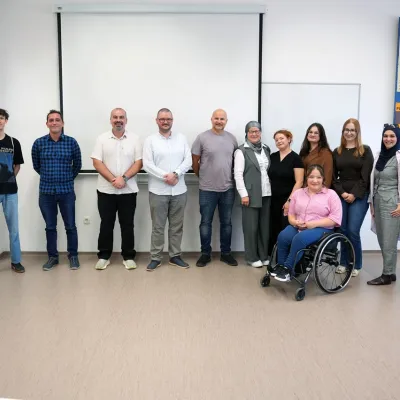
Group members:
Assist. Prof. Dr. Jasmin Sutkovic
PhD student Muhamed Adilovic
MSc student Esma Kurtanovic